

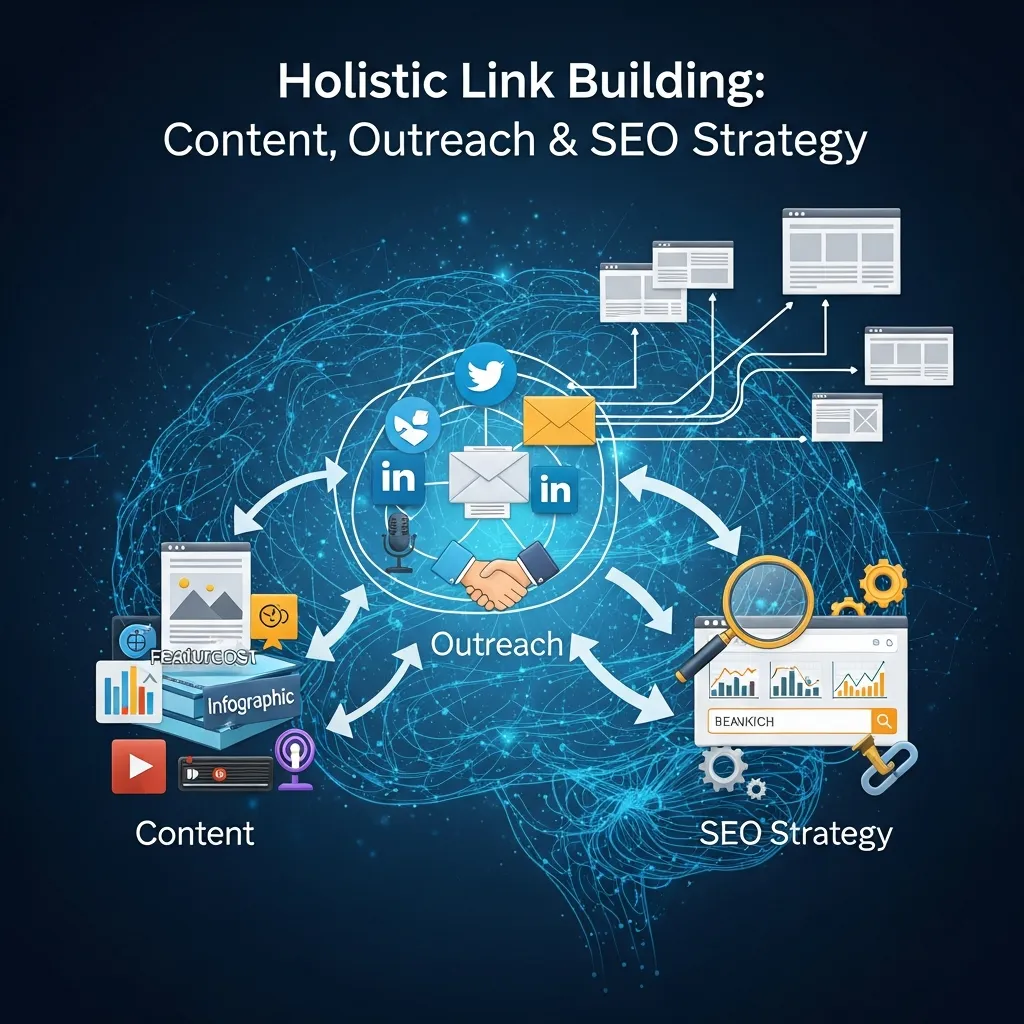
Struggling to boost your organic search traffic? Discover how holistic link building combines compelling content, targeted outreach, and technical SEO to skyrocket your online authority.
This comprehensive guide explores the intersection of content creation, relational outreach, and technical optimization to drive sustainable SEO success. You will learn actionable strategies, discover common pitfalls to avoid, and master expert techniques to secure high-authority backlinks that elevate your website rankings.
The Evolution of Holistic SEO Strategies
Search engine algorithms change constantly. In the past, marketers relied on isolated tactics to manipulate rankings. They purchased directory placements, spammed blog comments, and spun articles. Those tactics no longer work. Modern search engines demand quality, relevance, and authenticity. To succeed, you must adopt a holistic approach to link building. This method merges high-quality content, targeted outreach, and robust technical optimization into a single, unified strategy.
When you approach link building holistically, you stop chasing sheer numbers. Instead, you focus on securing placements that drive real referral traffic and build genuine brand authority. A successful link building campaign requires a deep understanding of your audience, a commitment to solving their problems, and the ability to communicate your value to other website owners. You must leverage your content marketing funnel to create assets that naturally attract citations while actively promoting those assets to the right people.
Every backlink serves as a digital vote of confidence. When authoritative websites point to your pages, search engines interpret this as a strong signal of trust. However, acquiring these votes requires more than just asking for them. You must give site owners a compelling reason to reference your work. This is where the holistic methodology outshines traditional tactics. By integrating your efforts, you create a sustainable engine for continuous growth.
Core Pillars of Holistic Campaigns
To build a robust backlink profile, you must support your strategy with three core pillars. Each pillar relies on the others. If one fails, the entire structure collapses.
High-Value Content Creation
Content acts as the foundation of any link building effort. Without exceptional content, you have nothing to promote. You must move beyond generic blog posts and create linkable assets. These assets include original research, comprehensive guides, interactive tools, and detailed infographics. When you publish unique data, other creators naturally reference your findings to support their own arguments.
Your content must answer specific questions and solve real problems. You must understand search intent and deliver exactly what the user wants. If your page provides the best answer on the internet, you make it incredibly easy for other webmasters to justify linking to you. Strong on-page SEO strategies ensure that your content remains easily discoverable by search engines, increasing the likelihood of earning passive backlinks over time.
Targeted and Personalized Outreach
Creating great content only solves half the equation. You must actively promote your assets to the people who can amplify them. Outreach forms the bridge between your content and your target audience. You cannot rely on automated, templated emails to secure high-quality placements. Effective outreach requires personalization, research, and relationship building.
Before you send a single email, you must identify the right prospects. Look for authors and webmasters who have previously linked to similar topics. Analyze their content to understand their audience and editorial standards. When you pitch your asset, clearly explain how it adds value to their specific article. Focus on how your link benefits their readers, rather than how it helps your link building metrics. Building genuine connections with industry peers yields far better results than cold, transactional requests.
Technical SEO Foundations
Even the best content and outreach strategies will fail if your website suffers from technical issues. Search engines must be able to crawl, index, and understand your pages. If a prospect clicks your link and encounters a slow-loading page or a broken layout, they will immediately navigate away and remove your link.
You must conduct a regular technical SEO audit to ensure your site performs optimally. Optimize your page speed, implement responsive mobile design, and fix any broken internal links. A clean, technically sound website provides a positive user experience, which encourages visitors to stay longer and share your content. Additionally, search engines reward technically optimized sites with better crawl budgets and higher baseline rankings, amplifying the impact of your link building efforts.
Aligning Search Intent with Content Strategy
Understanding search intent is critical for successful link building. Search intent refers to the underlying goal a user has when they type a query into a search engine. Are they looking for information? Do they want to make a purchase? Are they trying to navigate to a specific website? If your content does not match the user’s intent, it will not rank, and it will not earn backlinks.
Informational intent drives the majority of link building success. Users searching for information want detailed answers, step-by-step guides, and authoritative data. When you create comprehensive resources that satisfy informational intent, you position your brand as an industry expert. Other content creators, journalists, and bloggers constantly search for credible sources to back up their claims. By targeting informational queries, you increase your chances of becoming that credible source.
To align your strategy with search intent, you must perform rigorous keyword research techniques. Look beyond search volume and analyze the top-ranking pages for your target keywords. What type of content currently ranks? What questions do they answer? What formats do they use? Identify gaps in the existing content and create a resource that provides a better, more complete answer. When your content perfectly satisfies search intent, you create an irresistible magnet for high-quality backlinks.
Expert Insights on Acquiring Authority
Gaining traction in competitive niches requires advanced tactics. Industry experts rely on proven methodologies to secure placements on high-authority domains. Here are actionable insights to elevate your link building game:
- Leverage Digital PR: Treat your link building like a public relations campaign. Use platforms like HARO (Help a Reporter Out) or Help B2B Writers to connect with journalists seeking expert quotes. When you provide valuable insights, journalists reward you with high-authority media mentions.
- Reclaim Unlinked Brand Mentions: Monitor the web for instances where people mention your brand but fail to include a link. Reach out to the author, thank them for the mention, and politely ask if they would consider adding a link to your homepage or a relevant resource. This converts existing brand awareness into tangible SEO value.
- Capitalize on Broken Links: Find authoritative pages in your niche that contain broken external links. Reach out to the webmaster, alert them to the broken link, and suggest your high-quality resource as a replacement. You provide immediate value by helping them fix an error, increasing the likelihood of a successful placement.
- Build Resource Pages: Create comprehensive glossaries, industry tool lists, or ultimate guides. Webmasters frequently link to resource pages because they provide immense value to their readers. Once published, pitch your resource page to sites that maintain their own list of industry links.
Common Mistakes to Avoid in Your Campaigns
Many marketers sabotage their own efforts by falling into common traps. Avoid these link building mistakes to protect your website’s authority and maintain your search rankings.
- Prioritizing Quantity Over Quality: A single backlink from a highly respected industry publication carries more weight than hundreds of links from low-quality, spammy directories. Focus your energy on acquiring relevance and authority, not sheer volume.
- Ignoring Link Relevance: Search engines evaluate the context surrounding a backlink. If you run a financial software company, a link from a popular food blog provides little to no SEO value. Seek links from websites within your niche or closely related industries.
- Using Exact Match Anchor Text Excessively: In the past, marketers stuffed their anchor text with exact target keywords to manipulate rankings. Today, this triggers algorithmic penalties. Maintain a natural backlink profile by using a diverse mix of branded, naked URL, and descriptive anchor text.
- Neglecting Relationship Building: Treating outreach as a purely transactional process yields poor results. Webmasters receive dozens of link requests daily. You stand out by building genuine relationships. Engage with their content, share their articles, and establish rapport before asking for a favor.
- Buying Cheap Backlinks: Never purchase links from link farms or low-quality private blog networks (PBNs). Search engines easily detect these schemes and will penalize your website, destroying your organic traffic overnight. Read more about Google’s stance on link schemes on Google Search Central.
Content vs. Outreach: A Strategic Comparison
To fully grasp holistic link building, you must understand how content and outreach differ and complement each other. The following table breaks down their distinct roles within a unified campaign.
|
Feature |
Content Creation Focus |
Outreach Focus |
Holistic Integration |
|---|---|---|---|
|
Primary Goal |
Attract passive links through value. |
Actively secure placements and partnerships. |
Create assets that justify active promotion. |
|
Effort Type |
Front-loaded (research, writing, design). |
Continuous (prospecting, pitching, follow-up). |
Balanced allocation of resources. |
|
Key Metric |
Organic traffic, time on page, social shares. |
Placement rate, response rate, domain authority. |
Referral traffic, overall domain growth. |
|
Skill Required |
Subject matter expertise, copywriting, SEO. |
Communication, sales, data analysis. |
Cross-functional team collaboration. |
|
Time to Results |
Long-term (requires time to index and rank). |
Short-to-medium term (immediate link placement). |
Sustainable, compounding growth over time. |
Actionable Steps to Launch Your Campaign
Ready to implement a holistic link building strategy? Follow these precise steps to launch a campaign that drives measurable results.
Step 1: Conduct a Link Gap Analysis
Before you build new links, you must understand where you currently stand. Analyze your backlink profile and compare it to your top competitors. Use SEO tools to identify the websites linking to your competitors but not to you. This reveals immediate opportunities. If a website links to three of your competitors, they are highly likely to link to your resource, provided it offers superior value. Document these prospects and categorize them by authority and relevance.
Step 2: Develop Linkable Assets
Review the gaps identified in your analysis. What type of content attracted the most links for your competitors? Did they use original data? Did they create a comprehensive tutorial? Use this information to develop your own linkable assets. Do not just copy what exists; create something undeniably better. Incorporate fresh data, design custom graphics, and ensure your writing is clear and engaging. Your asset must serve as the definitive resource on the topic.
Step 3: Execute Personalized Outreach
With your asset published, begin your outreach campaign. Segment your prospect list based on why they should link to you. Are they mentioning outdated statistics? Do they have a broken link? Did they link to an inferior resource? Craft personalized email pitches for each segment. Keep your emails concise, professional, and focused on the value you provide to their audience. Always include a clear call to action, making it easy for the webmaster to review your content and add the link.
The Role of E-E-A-T in Link Acquisition

Google relies on the E-E-A-T framework—Experience, Expertise, Authoritativeness, and Trustworthiness—to evaluate content quality. This framework heavily influences link building. When you demonstrate deep expertise and firsthand experience, you naturally build trust with your audience and other creators.
Webmasters actively seek out trustworthy sources. If your content displays strong E-E-A-T signals, earning backlinks becomes significantly easier. To boost your E-E-A-T, always include author bios detailing your credentials. Cite authoritative external sources, provide transparent methodology for any data you present, and ensure your website features clear contact information and privacy policies. When other sites link to you, they transfer some of their own trustworthiness to your domain, creating a powerful feedback loop that elevates your entire web presence.
Measuring the Success of Your Links
You must track the performance of your link building campaigns to understand your return on investment. Do not simply count the number of links you acquire. You must evaluate the quality and impact of those links.
Monitor your referral traffic. Are people actually clicking on the links you secured? High-quality placements on relevant websites drive targeted traffic that converts. Track your keyword rankings. As you build a stronger backlink profile, you should see a steady improvement in your organic search positions for your target terms. Finally, monitor your overall domain authority using metrics like Moz’s Domain Authority or Ahrefs’ Domain Rating. While these are third-party metrics, they provide a useful benchmark for tracking your website’s growing influence over time.
By continuously analyzing these metrics, you can identify which tactics yield the best results. You can refine your outreach templates, double down on the content formats that attract the most links, and eliminate strategies that fail to deliver a positive return. Link building is an iterative process that requires constant measurement and adaptation.
Conclusion
Holistic link building requires a dedicated commitment to merging exceptional content creation, personalized outreach, and rigorous technical SEO. By moving away from manipulative tactics and focusing on genuine value, you establish a resilient foundation for long-term search visibility. Start creating linkable assets, building authentic industry relationships, and optimizing your technical framework today to dominate your niche and drive sustainable organic growth.
FAQs
1. What exactly is link building?
Link building is the strategic process of acquiring hyperlinks from other websites to your own. These hyperlinks act as votes of confidence, signaling to search engines that your content is valuable, authoritative, and worthy of ranking higher in search results.
2. Why is content quality so important for getting backlinks?
Content quality forms the foundation of any successful campaign. Other webmasters will only link to your pages if they provide immense value to their readers. High-quality, original content naturally attracts citations, making your outreach efforts significantly more effective.
3. How many backlinks do I need to rank on the first page?
There is no specific number. Ranking depends on the competitiveness of your keyword, the authority of the sites linking to you, and the quality of your own content. Focus on acquiring highly relevant, authoritative links rather than chasing an arbitrary quantity.
4. What is the difference between a “do-follow” and “no-follow” link?
A “do-follow” link passes SEO authority (link juice) from the linking site to your site, directly impacting your search rankings. A “no-follow” link contains an HTML tag telling search engines not to pass authority. While no-follow links do not directly boost rankings, they still drive valuable referral traffic and build brand awareness.
5. Is cold email outreach still effective for SEO?
Yes, but only when executed correctly. Generic, spammy emails rarely work. Effective cold outreach requires deep personalization, careful prospect research, and a clear articulation of how your content benefits the recipient’s audience.
6. Can technical website errors hurt my link acquisition efforts?
Absolutely. If you successfully pitch a link, but the webmaster visits your site and experiences slow loading times, broken images, or a confusing layout, they will abandon the site without placing the link. Technical optimization ensures you capitalize on every opportunity.
7. What is a broken link building strategy?
This strategy involves finding authoritative websites in your niche that contain broken external links pointing to dead pages. You contact the website owner, inform them of the broken link, and suggest your live, relevant content as a replacement to fix their error.
8. How long does it take to see results from these campaigns?
SEO is a long-term investment. It typically takes anywhere from three to six months to see noticeable movements in your search rankings and organic traffic after securing high-quality backlinks, as search engines need time to crawl, index, and evaluate the new signals.
9. Are directory submissions still useful for SEO?
Spammy, low-quality directory submissions actively harm your rankings. However, securing placements in highly curated, industry-specific directories or local business citations remains a valuable tactic for establishing baseline relevance and local authority.
10. How do I know if a backlink is high quality?
A high-quality backlink comes from a website that is topically relevant to your niche, boasts strong editorial standards, receives genuine organic traffic, and maintains a solid domain authority. A link placed naturally within the body of an informative article is always more valuable than a link hidden in a footer or sidebar.



Leave a Reply